Inference wants to be distributed — and now NVIDIA agrees
· @briancaffey·1 min read
For a long time, the obvious objection to a community inference network was "why would anyone do this when the hyperscalers have all the GPUs?" That objection is quietly falling apart, and the most interesting evidence didn't come from a scrappy open-source project — it came from NVIDIA.
Local models got good enough to matter
The first half of the story is the models. A year ago, "run it locally" meant accepting a real quality drop. That gap has closed faster than almost anyone expected. Small and mid-size open models now handle the bulk of everyday work — summarization, extraction, coding assistance, agent steps, chat — at a quality that would have been frontier-class not long ago. Reasoning models that think before they answer now ship in sizes that fit on a single consumer card. Quantization keeps improving too: the network's current default is a 30B reasoning model running in NVFP4 (4-bit floating point) on one box.
The implication is simple. When the model that's good enough for your task fits on a GPU that already exists in someone's home, the bottleneck stops being model quality and becomes access to compute and its economics. Inference is cheap at the silicon layer and expensive at the API layer, and modern consumer GPUs spend most of their lives idle. That arbitrage is the whole reason inference.club exists.
The grid is the real constraint — and NVIDIA just bet on the edge
The second half of the story is power, and this is where the news comes in. In April 2026, Span — the company that reinvented the home electrical panel — announced XFRA, a "distributed data center" built with NVIDIA as launch partner. (Span announcement · Business Wire)
The framing they use is the "speed-to-power gap." Centralized AI data centers are bottlenecked not by chips but by electricity: grid build-out takes the better part of a decade, and projects already in the pipeline can wait years just for an interconnection approval. U.S. data centers drew about 183 TWh in 2024 — roughly 4% of national electricity — and that's projected to climb past 9% by 2030. You cannot pour concrete and string transmission lines fast enough to keep up.
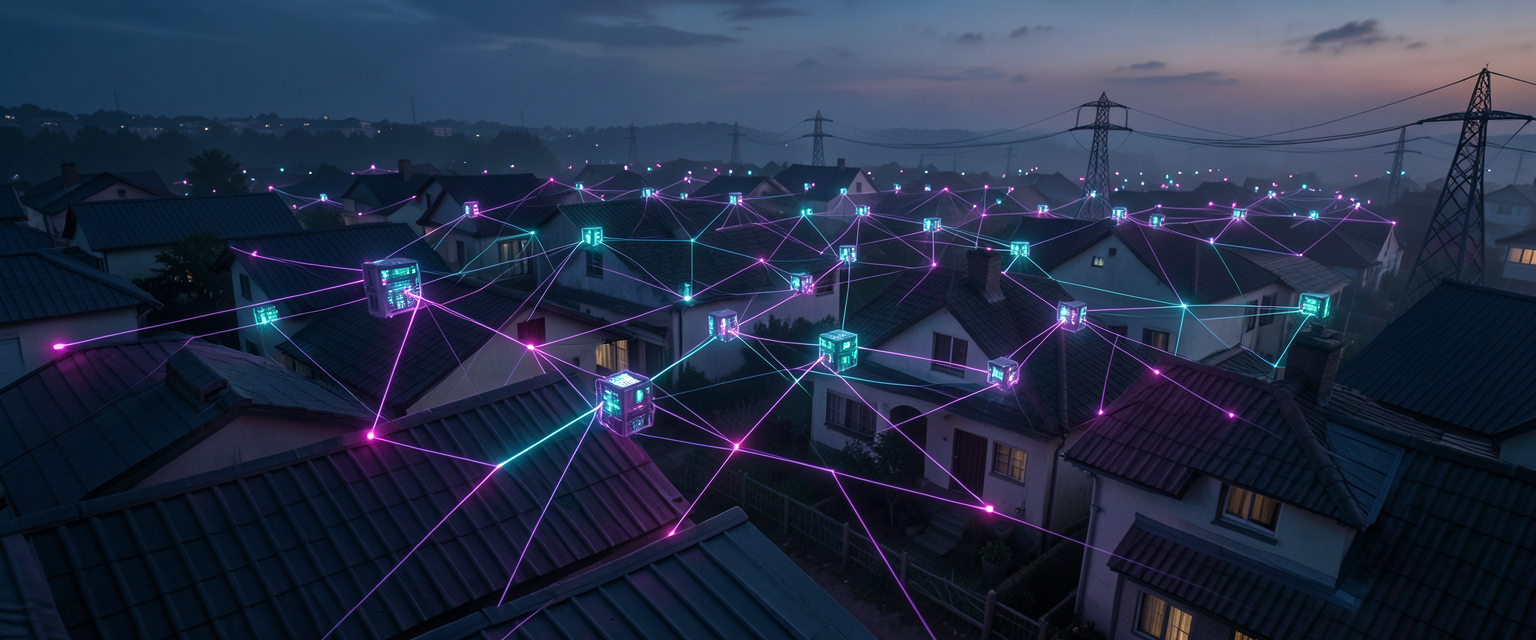
XFRA's answer is to stop trying to centralize. Instead of one giant facility waiting on a substation, it places enterprise GPU nodes — reportedly Dell PowerEdge servers with 16 NVIDIA RTX PRO 6000 Blackwell GPUs each, liquid-cooled — inside ordinary homes and small commercial buildings, and runs them on power that's already there. The insight is that a typical home uses only ~40% of its allocated electrical capacity on average, so the headroom to run a serious accelerator is sitting unused behind millions of meters. Span installs a smart panel and a backup battery at no cost to the homeowner, who gets discounted power and internet in exchange; Span says the result delivers inference roughly one-fifth the cost of building a comparable centralized facility, and far sooner. The plan is a proof-of-concept of 100 nodes in new-construction homes (likely Nevada or Arizona) in Q3 2026, scaling toward gigawatt-scale by 2027. (Data Center Dynamics · pv magazine USA)
Read past the specifics and the thesis is striking: the company that makes the GPUs is now actively investing in putting them at the grid edge, behind the meter, in people's homes. That is a direct vote against the assumption that all inference must live in hyperscale data centers. The economics and the physics both point toward distribution.
Same direction of travel, two different on-ramps
XFRA and inference.club are not the same thing, and the differences are the point.
XFRA is top-down and capital-heavy: brand-new, purpose-built, enterprise-grade nodes deployed into new homes by a well-funded company with a hardware partner. It's an infrastructure play, and a serious one.
inference.club is bottom-up and zero-new-hardware: it uses the GPUs people already own. The 4090 under your desk that does two hours of real work a day. The homelab 3090. The Mac Studio with 192 GB of unified memory. The dual-A6000 box left over from a project that wrapped. You run a small agent next to whatever OpenAI-compatible server you're already using, and that latent capacity becomes usable behind one shared API — for you, or for whoever you choose to share it with.
One builds new distributed capacity; the other unlocks the distributed capacity that already exists. Both rest on the same two bets: that local models are now good enough to do real work, and that the future of inference is spread across the edge rather than stacked in a handful of mega-campuses. When NVIDIA puts its flagship Blackwell silicon into that bet, it's a good sign the bet is right.
Why it matters for what we're building
For a community network, "big incumbents are validating the category" is close to the best news you can get. It means the hard, expensive questions — can distributed nodes meet inference workloads, is behind-the-meter power viable, will utilities and homeowners play along — are being answered with real capital by people whose job is to be right about compute.
inference.club is the lightweight, open, you-can-try-it-today version of that same idea. No new panel, no battery install, no waiting for 2027 — just an API key and the GPU you already have. As local models keep getting better and the grid keeps getting tighter, the value of every idle accelerator on the network goes up.
If you want to see it work, the five-minute quickstart gets you from sign-in to your first response — and if you've got a GPU sitting idle, you can put it on the network in about the same amount of time.
Sources: Span — XFRA announcement · Business Wire · Data Center Dynamics · pv magazine USA